Zurück zur Übersicht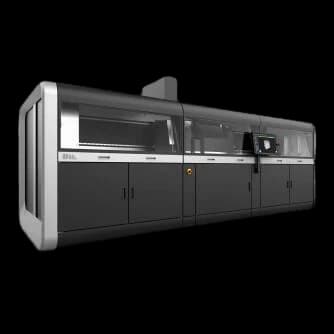 OTHER
OTHER
OTHERDesktop Metal Inc.
OTHERDesktop Metal Inc.
Developed by the inventors of binder jetting and single-pass inkjet technology, the Production System is the fastest way to 3D print metal parts. Thanks to high-resolution 3D printing and a uniform print bed, the Production System can produce dense, high-quality parts that perform in even the most demanding applications. With a native resolution of 1200x1200 dpi and layer heights as low as 50 µm, the Production System is a precision binder jetting system capable of producing 3D-printed parts with excellent surface finish and incredibly fine features. Proprietary constant wave distribution technology ensures that a consistent powder wave is maintained in front of the compaction roller during printing, improving density uniformity throughout the powder bed. The result is greater part consistency within each build and from build to build. 3D-print customer-ready parts with a density of up to 99% or higher, without requiring a filling or solvent debinding step. With casting-like properties, Production System parts are suitable for demanding applications where strength is critical. By using cost-effective MIM (Metal Injection Molding) powders, high-speed 3D printing, and the ability to densely nest many parts in a single build, part costs are competitive with those of traditional mass production techniques. The Production System uses the same cost-effective powders used in the MIM industry. This allows customers to access an established powder supply chain with the scale to support volume production, as well as a wide range of easy-to-use alloys. Up to 99% or more of the loose powder recovered during the process can be recycled, leading to further cost efficiencies while reducing waste. With the Production System’s bidirectional Single-Pass Jetting (SPJ) printing technology, up to tens of thousands of parts can be printed per day. Every pass of the print carriage is utilized to produce parts, achieving print speeds up to 100 times faster than laser powder bed fusion systems, thereby maximizing productivity. The Production System’s tool-free binder jetting 3D printing process means that parts are supported by loose powder and do not need to be fused to a build plate. This allows customers to fill the build volume with densely packed parts, enabling efficient, high-throughput production. The Production System offers robust repeatability through anti-ballistic technology, print beam redundancy, and optical print bed inspection. This means you can print with confidence. The patented anti-ballistic technology—designed to reduce disturbances in the powder bed—drastically reduces variability in the 3D printing process while increasing the print bar’s longevity. This enables reliable prints and excellent part quality. Full print bar redundancy is achieved through an anti-banding mechanism that realigns the print bar between layers, ensuring reliable binder deposition and suppressing defects that would otherwise compromise the quality of the final part. This mechanism eliminates the need for hard, nozzle-based redundancy while improving serviceability. An overhead camera monitors each layer using multi-angle imaging to detect printing errors and nozzle performance during printing. This facilitates part inspection and build verification, which are critical for the deployment of additive manufacturing in production environments. The Production System’s inert chamber, open material platform, and selection of binders developed by Desktop Metal enable 3D printing with a wide range of metals—from stainless steels to reactive metals and high-performance alloys. A closed powder environment—inerted to less than 2% oxygen—safely supports a range of non-reactive and reactive metals in a controlled manner. By isolating the powder from ambient conditions, it produces powder with consistent properties and quality, facilitating part uniformity and repeatability. The Production System features an open material platform that allows customers to source the same metal powders used in the MIM industry or custom alloys from a supplier of their choice, keeping costs low and ensuring compatibility with mass sintering processes. The binders developed by Desktop Metal’s materials scientists are formulated to support a wide range of alloys and maximize success at every stage of the binder jetting process—ensuring jettability during printing, green part strength during debinding, and clean burn-off prior to sintering. The Production System uses single-pass jetting and offers bidirectional 3D printing—whenever there is movement, printing occurs. In bidirectional single-pass jetting, all steps of the printing process—powder application, distribution, compaction, ballistic suppression, and binder jetting—are performed with each pass over the build area. Layer by layer, metal powder and binder are applied until the entire build volume is filled with bound parts and surrounding loose powder. When a build cycle is complete, the build box is removed and replaced with a new box for the next build cycle. The finished build box is moved to a depowdering station, where loose powder is removed and the parts are prepared for sintering. The depowdered parts are loaded into an industrial furnace, where they are heated to temperatures near the melting point. The remaining binder is removed, causing the metal particles to fuse together and the parts to consolidate. The P-50 is the fastest way to 3D print metal parts at scale. It utilizes Desktop Metal’s patent-pending single-pass jetting technology and bidirectional printing to achieve speeds up to 100 times faster than laser powder bed fusion technologies. Equipped with a state-of-the-art print head with native 1200 dpi resolution, an inert processing environment, and constant wave distribution for a uniform print bed, the P-50 delivers the quality, reliability, and cost-effectiveness required for high-volume end-use applications.
Druckertyp
OTHER
Build Volume
500 × 400 × 500 mm
Layer Resolution
50 μm
* Affiliate-Link: Bei einem Kauf über diesen Link erhalten wir eine Provision – für dich entstehen keine Mehrkosten. Mehr erfahren

* Preise inkl. MwSt., zzgl. Versandkosten. Bei einem Kauf über diese Links erhalten wir eine Provision – für dich entstehen keine Mehrkosten. Letzte Aktualisierung vor kurzem.
Keine Preisdaten verfügbar
Noch keine Bewertungen
 OTHER
OTHERCreality
 OTHER
OTHERDesktop Metal Inc.
 OTHER
OTHER OTHER
OTHERPrusament